A street laid out in 1976 and one finished in 2014 can both back up, but they should not be cleaned the same way. The older one has had decades for roots to find joints and scale to build in iron. Where the pipe is sound, jetting works well. Where it is not, the camera has to say so before any water moves.
What 1970s and 1980s Construction Means for Brandon FL Hydro Jetting
Census estimates for Brandon count 7,720 homes built in the 1970s and 10,619 in the 1980s, which together are 37.5% of the housing stock; 23.0% predates 1980. Those are citywide figures; your street may differ.
Pipe material follows the era only loosely. As a typical pattern, houses from before about the mid-1970s may have cast iron or clay drains, and some may have fiber (Orangeburg) sewer pipe; houses from the late 1970s onward are more likely ABS or PVC. Typical is not guaranteed; repairs mix materials inside one house.
County main records are a partial guide. Providence Lakes mains are all PVC, laid 1984-1997. Around Barrington Oaks the county lists 203 PVC, 5 vitrified clay, 3 ductile iron and 1 concrete main among 217, and in Brandon Hills about 37% of the 1970s mains have no recorded material. Those are public mains. The private pipe from your house to the street is a different record, and often no record. Our post on what county sewer records show about Brandon’s older subdivisions explains the gap.
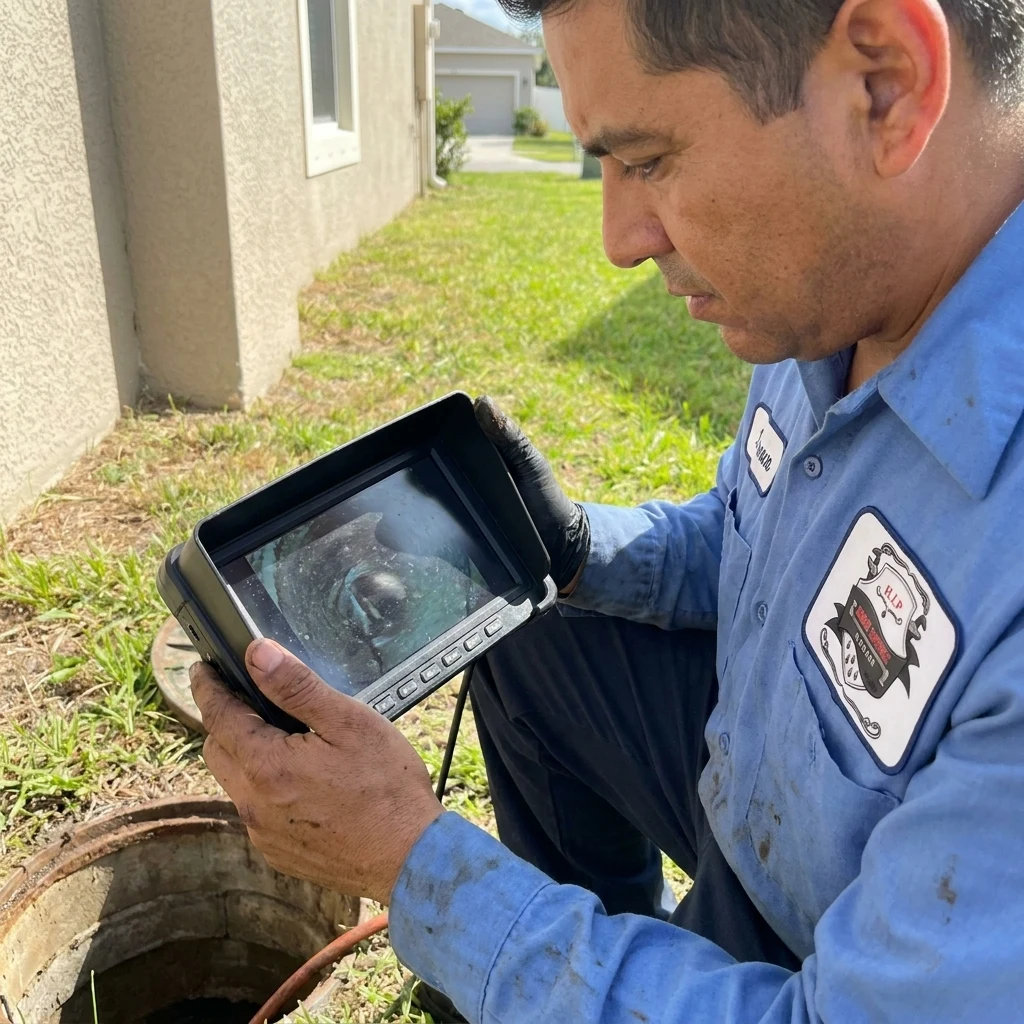
Why the Camera Goes First on an Older Lateral
A sewer camera inspection answers four questions in a few minutes: what the pipe is made of, whether the joints line up, whether there is a sag holding water, and what exactly is causing the stoppage.
Then a second pass after jetting confirms the pipe wall is clean and nothing shifted. A stand-alone camera inspection is $150-$300 and is often credited toward the work the same visit, so on an older house it is rarely a pure extra cost.
Hydro Jetting Pressure for Old Pipe: Why We Never Max It Out
Pressure (psi) is the cutting force. Flow (gpm) is what carries debris out. One equipment guide pairs 2- to 4-inch residential laterals with 8-10 gpm at 3,500-4,000 psi and notes that going above 4,000 psi is rarely necessary for sewer lines. A plumbing company’s guide advises older cast iron be jetted conservatively, typically under 2,800 psi, with descaling nozzles, because the rust scale may be what is holding the pipe together. For clay with aligned joints and no active cracks it cites 2,500-3,000 psi to clear roots, and 1,500-2,500 psi for interior drain lines.
Those sources do not agree on one number, and we do not publish one as a rule. Our practice is to start low, step up only as far as the camera shows the pipe can take, and watch the monitor while we do it. Nozzle size and distance change the pressure that reaches the pipe wall, so the gauge is not the whole story.
What Jetting Can and Cannot Do on Aged Pipe
- Can: wash grease, silt and loose scale off the wall; cut root hairs and light root growth out of joints; restore flow in a sound pipe.
- Cannot: close a crack, straighten an offset joint, lift a bellied section, or rebuild a corroded pipe wall.
- Should not: run through Orangeburg fiber pipe, a collapsing section, or a line the camera shows cracked at the point of blockage.
See also root removal and line clearing and sewer line hydro jetting.

Signs We Stop and Recommend a Repair Plumber in Brandon
These findings end the jetting plan:
- A crack or a section that is flattening or collapsing.
- Joints offset enough that the nozzle catches or water leaves the pipe.
- A sag that stays full of water after the line is cleared.
- Fiber pipe anywhere in the run.
- A blockage that is an object or a broken fitting rather than roots, grease or scale.
We do not offer pipe repair, lining or replacement, so when one of these shows up we say so and send you to a plumber with the video in hand.
Older Brandon Neighborhoods Where the Camera Matters Most
The surrounding census tract for Barrington Oaks and Kings Avenue has a median build year of 1976, and 75.0% of its homes predate 1990; see Barrington Oaks and Kings Avenue. Brandon Hills has county mains from the 1970s with a median install year of 1977. Limona mains span 1973 to 2013, and Heather Lakes has six asbestos-cement mains among its 294 recorded segments.
What to Ask for in Writing Before an Older Line Is Jetted
- A camera pass before work, with the video shared with you.
- The nozzle type and the pressure ceiling the technician plans to use.
- The stop rule, and what you pay if the line cannot be jetted.
- A second camera pass after, if you want proof the pipe is clean.
The same checklist, line by line, is in reading a hydro jetting estimate for older cast iron and clay lines.
Older house, slow main line?
Same-day camera and jetting visits in Brandon, with a written price before work starts and a 100% satisfaction guarantee.
CALL 813-733-7188Older Home Jetting in Brandon, FL: Common Questions
Often yes, when the camera shows a sound pipe and the pressure is set for the material. Damage comes from jetting an older line with settings meant for new PVC. We look first, choose a nozzle and pressure for the monitor picture, and stop if the pipe cannot take it.
Nobody can say from the build year alone. Houses from before about the mid-1970s may have cast iron, clay or fiber pipe, and later ones are more likely ABS or PVC, but that is a typical pattern, not a guarantee. A camera run through the cleanout shows the actual material and condition.
It means the camera found something jetting would make worse: a crack, a collapsing section, offset joints, a sag, or fiber pipe. You get the video and a plain explanation, and we recommend a repair plumber. The camera fee of $150-$300 is often credited if we clean the same visit.
Sometimes. Clay with aligned joints and no active cracks can take a cutting nozzle at moderate pressure, and the camera pass before and after tells us whether it did. If roots have already split the pipe, clearing them only reopens the flow temporarily and a repair is the real fix.
Hillsborough County records show most Brandon mains are PVC, but those records cover the main, not your private line. If sewage is backing into the house, the county asks you to call Water Resources at (813) 307-1000. We work on your side: camera, jetting and clearing.