Root Removal in Brandon Sewer Laterals: Cut First, Flush After
A root in a sewer line is a symptom. It got in through a joint, crack or loose connection where moisture escapes, then branched into hair-fine threads that catch paper and fat until the line stops. Cutting the mass restores flow but does not seal the opening, so the honest question is always how quickly it comes back.
We remove roots mechanically. A cutting nozzle on a jetter spins on the water stream and shaves the mass off the pipe wall, a cable machine can carry a cutter head for a stubborn plug, and water then flushes the cuttings so they do not lodge at the next joint. A foam or liquid poured from a toilet tends to thin out before it reaches a joint and can only act on what it touches, so we cut first and talk about any product afterward.

Clues That Roots, Not Grease, Are the Problem
A grease clog and a root clog feel alike at the sink. These signs tell them apart:
- The cable or cutter comes back with stringy tan or brown fibers rather than slick paste
- The line slows again in the same stretch every few months
- Several fixtures slow together rather than one
- A cable clears things for months, then the same sluggishness returns
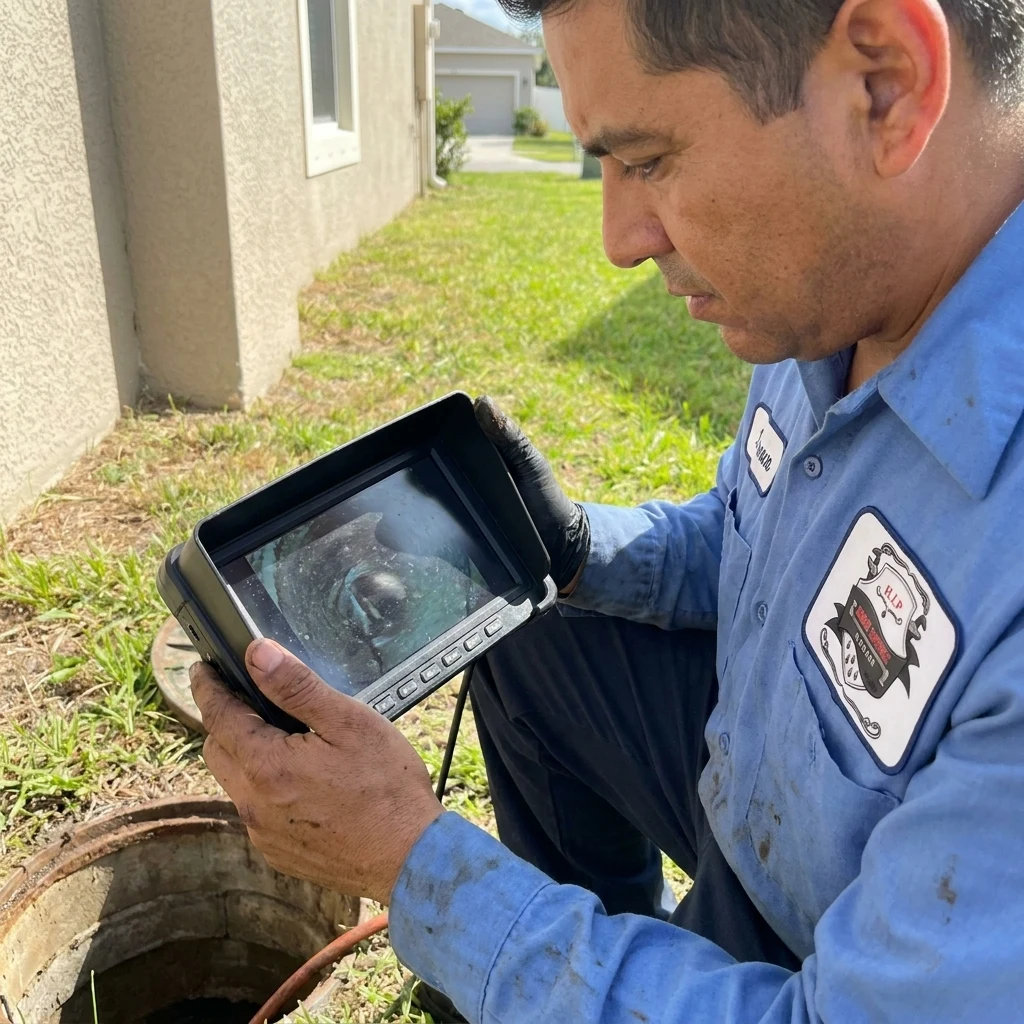
- Camera footage shows threads or a mass at a joint
- The house is older, and the private pipe may be clay or another jointed material
Where Roots Are Likelier in Brandon, and Where They Are Not
Our research does not support naming a particular tree as the culprit, so we will not. It does support looking at the pipe. County main records around Barrington Oaks and Kings Avenue list 5 vitrified clay mains among 217, and clay runs in short sections with a joint at each end, so each one is a place a root can find. The area sits on well-drained Candler sand, where roots may travel farther toward moisture, a reasoned guess and not a finding. Brandon Hills streets were sewered in the 1970s and about 37 percent of the county’s material records there are blank, another reason to look first.
Newer streets rarely have clay. County mains in Providence Lakes and Brandon Pointe are PVC, so roots there are a smaller worry, and roots inside a PVC lateral usually mean a loose or leaking joint. Where footage shows none, we look for grease or wipes instead, as the camera inspection page explains. Our older-homes guide covers which older pipes can take a cutting nozzle at all.
Root Removal Pricing, and When Cutting Only Buys Time
Cabling a main line runs $225 to $450. Jetting a main line with moderate roots runs $400 to $750, heavier masses toward the top of that range. The price is in writing before work starts, the estimate holds for 30 days, and a camera pass at $150 to $300 shows the entry point if you want to see it.
Cutting a root out of a pipe with an offset, a crack or a separated joint buys months, not years, because the root returns to the same opening. If the camera shows one, we say so and recommend a plumber or repair contractor; we do not dig, line or replace pipe. Fiber (Orangeburg) pipe is never jetted at all. And if no root shows up on the footage, we tell you the blockage is something else rather than sell you root work.
Root Removal in Brandon FL: Old Clay Joints, Wet Soils and River Edges
Roots enter a line at a joint. These sections have county records of clay main pipe, shallow water tables or river edges beside them.
- Brandon Tradewinds — Early 1970s construction, with clay sewer mains from 1971 in county records. Roots tend to enter clay pipe at its joints.
- Tanglewood — The county lists 13 clay main segments installed in 1974. A Tanglewood Way home is listed as built in 1975.
- Oakmont Park — Built from 1976 to 1978 in a cluster mapped as Candler sand, which drains fast; roots tend to go toward moisture, such as a leaking joint.
- Providence Lakes, Units I and V — Mapped as Myakka fine sand, with a wet-season water table as shallow as about 12 inches, which tends to keep roots shallow.
- Heather Lakes, Unit 24 and Old Field Drive — Built in 1985 in an area of Smyrna and Immokalee soils, where the wet-season water table sits as shallow as about 12 inches.
- Southwood Hills, Bloomingdale — County records date its pump station to 1973, so these laterals are among the older ones in Bloomingdale, close to 50 years in service.
- River Crossing Estates and Riverglen — Riverglen Units 3 to 7 date to 1997 and River Crossing to 1996, in the southern part of Bloomingdale, near the Alafia River.
- River Hills Country Club, Valrico — The east side borders county conservation land and trails run along the Alafia River, so the tree line sits close to the lots.
Brandon FL Root Removal Near the Alafia, the Hillsborough and the Preserves
Rivers and preserves keep the tree line close to the lots. These are the green edges of the territory.
- Alafia River — A spring-fed blackwater river whose North and South Prongs meet at Lithia. Bridges cross it at CR-39, Lithia Pinecrest Road and Bell Shoals Road.
- Alafia River Corridor Nature Preserve — County-managed land with trailheads on Highway 39 about a mile north of Highway 640.
- Lithia Springs Regional Park — 160 acres, with a spring averaging 35 million gallons a day at about 72 F, roughly 500 feet from the Alafia.
- Bell Creek Nature Preserve — 477 acres at 10940 McMullen Road in Riverview, county land beside newer subdivisions.
- Morris Bridge Park — A county park and boat ramp on the Hillsborough River in the Thonotosassa area.
- Lake Thonotosassa — The largest natural lake in the county, ringed by Taylor Road, Thonotosassa Road, McIntosh Road and Knights-Griffin Road.
- Alderman's Ford Regional Park — County park with entrances from Thompson Road and State Road 39, on the Alafia River corridor south of Plant City.
Tree Root Numbers Behind Brandon FL Sewer Line Clearing
Local extension research and the trade guides say a good deal about how far roots travel and how hard a line can be cleared.
- UF/IFAS Extension says most tree roots sit in the upper 12 to 18 inches of the soil. That shallow layer is where roots reach the joints of shallow lines; a camera shows how deep a given lateral runs and how many joints a mass has opened.
- UF/IFAS Extension reports that tree roots can reach three to four times the distance of the drip line when allowed to. A tree does not have to stand in your yard to reach the pipe; a neighbor's oak or a roadside tree can send roots across a lot line to a lateral.
- Tampa's January mean daily low is 52.8 F and the annual mean temperature is 74.5 F (NOAA 1991-2020 normals). With winters that mild there is little off-season for roots, so a cleared line can start collecting fine roots again; a camera recheck decides how often to return.
- One plumbing-company guide says clay pipe with aligned joints and no active cracks can take 2,500 to 3,000 PSI to clear root intrusions. Pressure that is safe in sound clay can break a cracked section, so the camera comes before the nozzle and the cutting head stays gentle on old clay.
- Brandon has 3,560 housing units built before 1970, 7.3% of its 48,953 units (ACS 2020-2024). The pockets with the most years behind them are where trees have had the longest to grow and a joint the longest chance to open, so root work comes up there most.
Fibers on the cable?
If a cable or another plumber has already pulled stringy roots out of your line, say so on the phone. It changes the tool we bring and how soon a camera should follow.
CALL 813-733-7188Older Streets Where Jointed Pipe Meets Mature Lots
Root calls follow pipe age and joint type, so the older sections come up first, among them Valrico, Seffner, Plant City, Temple Terrace, Bloomingdale, Limona, Brandon Hills, Brentwood Hills and Barrington Oaks & Kings Avenue. Newer streets get roots too, usually at a leaking joint, so ask if you are not sure.
Roots, Joints and Pour-In Products
It depends on whether the entry point is still open. Cutting clears the mass without sealing the joint, so a loose joint can refill. The camera shows how big the opening is, and a small one may be managed with periodic cutting while a large one belongs with a repair contractor.
We found no independent test showing that an enzyme product clears a roots or grease-packed sewer lateral. EPA says septic tanks already hold the microbes they need and finds no evidence that additives help there. See our enzyme products article for details.
It can if the pressure or the nozzle is wrong. One plumbing-company guide says clay with aligned joints and no cracks can take about 2,500 to 3,000 psi for roots, and that older cast iron should stay under about 2,800. That is attributed trade guidance, so we let the camera decide.
Yes, but less often. PVC comes in long sections with fewer joints, and a root there usually means a loose, offset or leaking joint. A camera pass finds it. If none shows, grease, wipes or a belly are the likelier causes of your slowdowns.
On an older or unknown pipe, yes, because it shows whether the pipe can take the cutter at all. On a newer pipe with a clear root history it is optional. The stand-alone camera is $150 to $300 and is often credited toward the work the same visit.