Thonotosassa Hydro Jetting and Drain Cleaning, Lake to Interstate
Lake Thonotosassa, the largest natural lake in Hillsborough County, anchors a community bounded by the Hillsborough River on the north, I-4 on the south and I-75 on the west. Population went from 6,091 in 2000 to 15,238 in 2020, and 20 percent of housing units were built in 2010 or later. Yet 51.4 percent predate 1990, and 39.2 percent of all units are mobile homes. Gated Grand Oak Glen and recent builds in Heritage Estates sit within a few miles of older 1960s houses in Jefferson Heights.
A grid check of county service-area maps inside the community found only 12 of 84 points in a wastewater service area, so many properties are likely on septic. Per-lot setup is not public, and listings for the same subdivision even disagree, which is why we confirm on the call.

Fast-Draining Sand and What It Hides
Soil at the sample points is Candler fine sand, excessively drained. Sand like that can swallow a leak without a puddle, so a slow lateral or a failing joint may not leave the wet patch that warns a homeowner. Because the surface rarely shows underground trouble, a camera is the dependable way to find it.
The state has set nutrient limits for the lake, and DEP's documents do not blame septic systems; it is simply one more reason to keep tanks and lines in good shape on a watershed that feeds the Hillsborough River.
What Each Service Means Around Lake Thonotosassa
- Hydro Jetting Services — Used on newer-subdivision kitchen lines and for clean-bore jetting up to a tank inlet, never into the field.
- Sewer Line Hydro Jetting — Where a county lateral exists it is a normal job; on many properties the 'sewer line' ends at a septic tank, and we say so.
- Kitchen Line Grease Jetting — Grease protects no one's tank; a kitchen-branch jet helps the pipe and the tank downstream.
- Root Removal & Line Clearing — Roots are hard to spot on sandy lots; a cutter nozzle clears them and the camera shows whether they came back through a joint.
- Drain Cleaning & Snaking — The default tool for mobile-home plumbing, which accounts for close to 40 percent of the housing here.
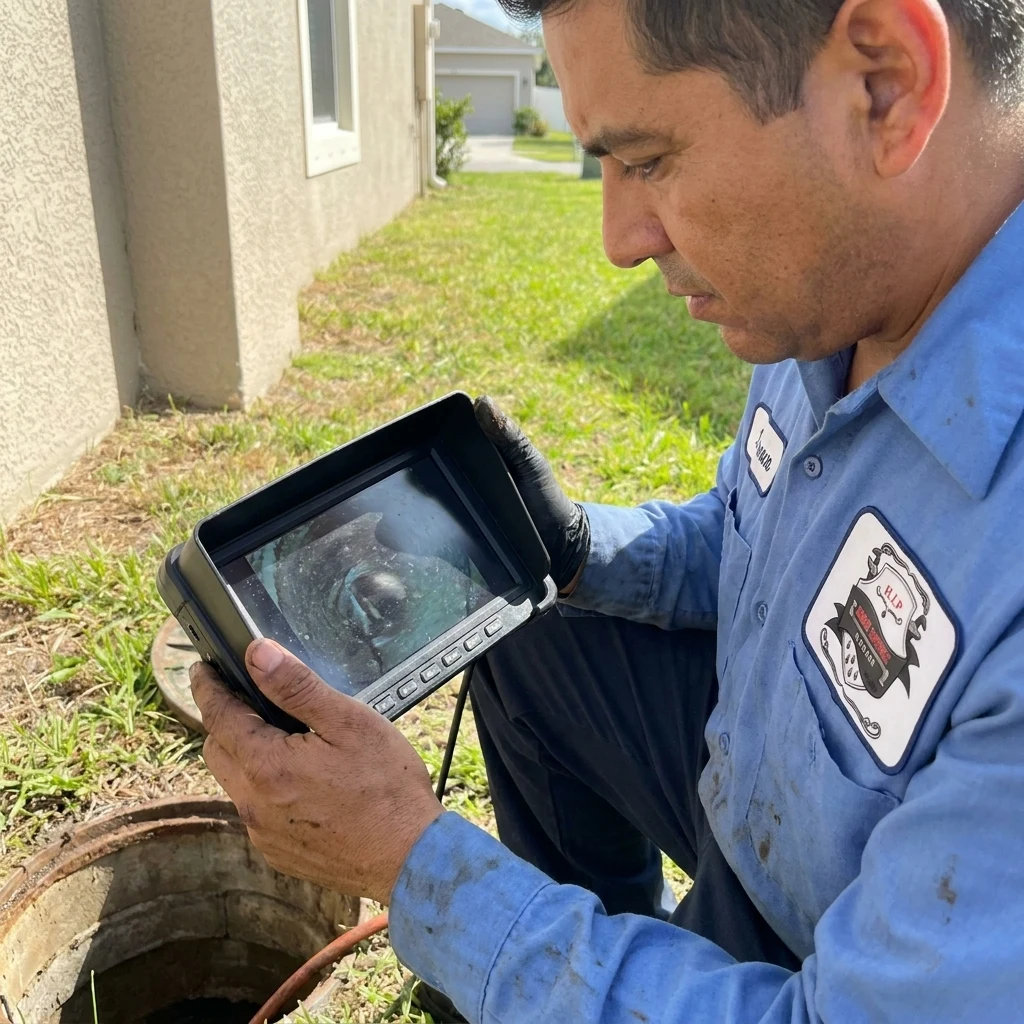
- Sewer Camera Inspection — The best way to find trouble in fast-draining sand, where leaks vanish without a wet spot.
Manufactured Homes, Lake Lots and Newer Builds
Roughly 2,350 of the community's 6,000 housing units are mobile homes, with shallow, thin-wall drains on short runs. A cable or a low-pressure jet is the safe choice, as the article on mobile-home drain lines explains. For pipe that connects to a tank we work to the inlet and stop; drain cleaning is the usual tool.
Newer subdivisions like Stonelake Ranch and Heritage Estates behave like other new builds: grease, wipes and builder debris, not age. Kitchen lines there respond to a single jetting pass, and the cost guide shows where a quote moves.
Thonotosassa Communities Around the Lake
Thonotosassa ranges from 1960s houses to 2024 builds, and county service maps show sewer only along its west edge, so septic is a standing question.
- Stonelake Ranch — Lake-view phases on Stonelake Ranch Boulevard; listings disagree about sewer versus septic, so it is checked house by house.
- Grand Oak Glen — Gated community with listed homes built in 2017 and 2018; county service maps draw sewer and county water over its point, unlike most of Thonotosassa.
- Heritage Estates — Phases 1 and 2, with Dolphin Gull Circle homes listed as 2024 builds, some on one-acre lots.
- Pine Ridge Estates — Manufactured homes; a 2016 home on Cliffside Place is listed with well water and a septic tank, though that is a single listing.
- Jefferson Heights — Older site-built homes, including a 1966 house on Floral Lane, so pipe age leans older than the newer subdivisions nearby.
- Langshire Village — Phases I and II on a resale-value site; no build era or sewer arrangement is published.
- Flint Lake Estates — Small private enclave on Flint Estates Drive where listings show 2022 to 2026 custom builds with new plumbing.
Thonotosassa Roads, Lake Access and Landmarks
I-4 bounds Thonotosassa on the south and I-75 on the west, with Lake Thonotosassa and the Hillsborough River defining the rest.
- Interstate 4 and Interstate 75 — The southern and western edges of the community, and the commute routes toward Tampa and Lakeland.
- US-301 and Fort King Road — The historic military road between Fort Brooke and Fort King; US-301 passes about a quarter-mile northeast of the lake.
- Lake Thonotosassa — The county's largest natural lake at more than 800 acres, ringed by Taylor Road, Thonotosassa Road, McIntosh Road and Knights-Griffin Road.
- Hillsborough River — North boundary, receiving the lake's outflow and supplying City of Tampa drinking water.
- Baker Creek Public Boat Ramp — The lake's main public access, with the John B. Sargeant ramp at the Flint Creek and river confluence.
- Morris Bridge Park — Free county boat ramp on the Hillsborough River, north of the lake.
- Thonotosassa Main Street Park — At 10238 Main Street with a football field, playground and restrooms.
- Folsom and Thonotosassa Elementary — Folsom is at 9855 Harney Road and Thonotosassa Elementary at 10050 Skewlee Road.
Thonotosassa Septic, Sand and Housing Facts
Hillsborough County's maps and the Census agree on the picture: older housing, many mobile homes and sewer mostly confined to the west edge.
- 2,352 of Thonotosassa's 5,999 housing units (39.2 percent) are mobile homes, plus 161 boat, RV or van units. Mobile homes typically have shallow plastic drains on short runs and often a septic tank beyond, which calls for different tools and lower-pressure jetting.
- In an 84-point grid laid over the community and checked against county service maps, 12 points fell inside a wastewater service area and 20 inside a county water area. Most of Thonotosassa therefore appears to be on septic and well; jetting clears the pipe up to a tank but not the drainfield, and we confirm each address.
- Thonotosassa's median home was built in 1989, and 3,084 of its 5,999 housing units (51.4 percent) predate 1990. Drain lines from the 1970s and 1980s are candidates for scale and root intrusion, which makes a camera check the sensible first step.
- Florida DEP's nutrient limits for Lake Thonotosassa compare 21,943 pounds a year of phosphorus in the 1999-2010 baseline with 3,137 pounds allowed, an 89 percent cut. The DEP summary does not blame septic systems, but nutrient limits put attention on household wastewater; we clear pipe up to a tank, while tank pumping stays with a septic contractor.
- Thonotosassa grew from 6,091 residents in 2000 to 15,238 in 2020, and 1,213 of its housing units (20.2 percent) were built in 2010 or later. Brand-new subdivisions and 1980s housing sit a few miles apart, so pipe ages and needs differ sharply within a short drive.
- Soil maps classify sampled Thonotosassa points as Candler fine sand, excessively drained, at ground elevations of about 43 to 50 feet. Sandy, fast-draining soil lets a leak vanish underground with little to see on the surface, which makes a camera the dependable way to find a problem.
Septic tank or county sewer? Start by telling us which
Most of Thonotosassa sits outside the mapped sewer areas, so the first question is where your line ends. Share that, the street and what is slow, and the written price follows.
CALL 813-733-7188Thonotosassa Septic, Sand and Small-Line Questions
County service-area maps cover only a small part of the community, which suggests many properties are on septic and wells. Individual lots are not documented publicly, and some newer subdivisions may differ. Check your paperwork or ask the county utility line at (813) 307-1000, and tell us what you learn.
The soil is excessively drained sand. Water from a leaking joint can soak straight down instead of pooling, so the lawn stays dry while the pipe is in trouble. If a drain keeps slowing for no visible reason, a camera is the practical way to look.
The newer house has plastic drains and, probably, few problems beyond grease, wipes or construction debris. The older one may have iron, clay or early plastic, with scale or roots. Same service, different approach: we use a camera first on the older line.
Usually, yes. Same-day service is our standard, and Thonotosassa is roughly nine miles from Brandon as the crow flies. Call with the street and the problem and we will give you a realistic time on the phone. For an active backup, use the 24-hour emergency line.
A camera usually can. If the pipe is clear all the way to the tank inlet and the level there is high, the trouble is the tank or the field, which a septic contractor handles. If the blockage is upstream, a cable or jet clears it.
Around Thonotosassa on I-4 and I-75
Seffner
Just south across I-4, a more sewered, mostly owner-occupied town.
Mango
Also south, with a similar share of mobile homes and more renters.
Plant City
Thirteen miles east, where homes are older and a city utility handles sewage.
Dover
Rural, mostly septic and well, with the same thin-wall small-line issues on the east side of the county.